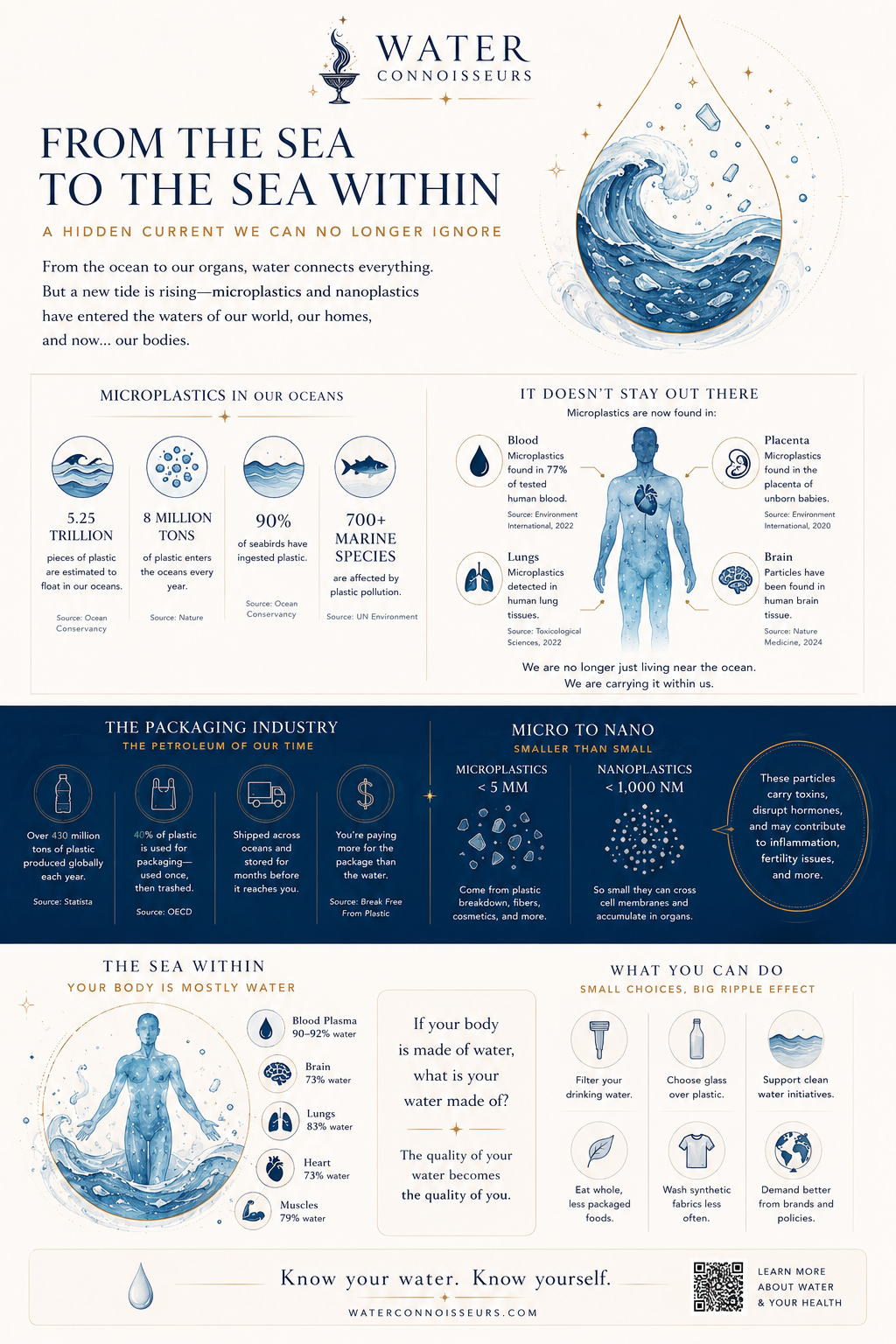

A small bottle of water may look inexpensive and harmless. But when bottled water becomes a daily habit, the true cost reaches far beyond the checkout line.
It affects our finances, our exposure to plastic, our oceans, and the living mineral-water system within the body.
The sea around us and the sea within us are connected.
✦ One
What Do Mini Water Bottles Really Cost?
Costco has listed an 80-count case of Kirkland Signature 8-ounce water bottles for approximately $10.77 through Costco Same-Day, although prices vary by location and delivery method. That equals about 13.5 cents per bottle.
For one person drinking 64 ounces each day:
- Eight mini bottles per day
- 240 bottles per month
- Three cases per month
- About $32.31 per month
- About $387.72 per year
- 2,880 plastic bottles per year
For a household of four, that becomes approximately $129.24 per month and more than 11,500 bottles each year.
That does not include water used for cooking, tea, coffee, exercise, pets, guests, or travel.
A few small bottles a day quickly become thousands of containers.
✦ Two
A Plastic Bottle Does Not Disappear
Some bottles are recycled, but many are burned, buried in landfills, littered, or carried into waterways.
Plastic does not simply vanish. It breaks into smaller and smaller pieces.
Current estimates suggest that approximately 1 to 2 million metric tons of plastic enter the oceans each year, while the world generates roughly 350 million metric tons of plastic waste annually.
The environmental cost begins long before the bottle is discarded. Petroleum and natural gas are used to make the plastic. Energy is required to manufacture, fill, package, refrigerate, transport, and sell the water.
The total burden includes:
- Plastic production
- Bottling and packaging
- Transportation emissions
- Cardboard and shrink-wrap
- Recycling and landfill demands
- Litter entering rivers and oceans
- Long-term fragmentation into microplastics
Convenience has a footprint.
✦ Three
Microplastics and Nanoplastics in Bottled Water
In 2024, researchers used advanced imaging to examine bottled water from three common brands.
They found an average of approximately 240,000 microplastic and nanoplastic particles per liter, with roughly 90 percent identified as nanoplastics. The measured range was approximately 110,000 to 370,000 particles per liter.
These particles may come from the bottle, cap, bottling process, filtration equipment, or abrasion during storage and handling.
The smallest nanoplastics are especially important because scientists are studying their ability to cross biological barriers and enter human tissues.
Research is still developing, but the exposure itself is no longer theoretical. Plastic particles have been detected in drinking water, food, air, oceans, and human tissues.
✦ Four
What Happens While Water Sits in Plastic?
Water stored in plastic may be:
- Low in dissolved gases
- Flat in taste
- Warm or poorly stored
- Exposed to packaging compounds
- Contaminated after opening
- Low in mineral content, depending on its source and treatment
Heat, sunlight, bottle damage, long storage periods, and repeated reuse may increase the movement of plastic-related compounds into the water.
This is one reason cases of bottled water should not be stored for long periods in hot cars, direct sunlight, garages, or near chemicals.
The longer water remains in contact with plastic, the more important its storage conditions become.
✦ Five
The Sea Within
The water inside the human body is not plain water.
Our internal fluids contain sodium, potassium, magnesium, calcium, chloride, phosphate, and other electrolytes. These minerals help regulate fluid movement, nerve signals, muscle contraction, cellular communication, and energy production.
Cells depend on mineral gradients and membrane pumps to move fluids and nutrients in and out.
Hydration exists within a living mineral-electrolyte system.
This is the sea within us.
When we think about water quality, we should therefore think beyond quantity. We can ask:
- What is in the water?
- What has the water been stored in?
- How long has it been stored?
- Has it been exposed to heat?
- Does our diet provide the minerals our cells require?
- Are our hydration habits nourishing us while also protecting the environment?
✦ Six
Plastic, Hormones, and Breast Health
Researchers continue to study chemicals associated with plastics because some can interfere with hormone signaling.
Certain plastic-related compounds have demonstrated estrogen-like activity in laboratory research. This matters because breast tissue is responsive to hormones, and many researchers are investigating how long-term exposure to endocrine-disrupting chemicals may influence breast development and cancer susceptibility.
It would be inaccurate to say that a plastic bottle alone directly causes breast cancer. Breast cancer has many contributing factors.
However, reducing unnecessary plastic exposure is a reasonable precaution, especially when reusable alternatives are readily available.
✦ Seven
Microplastics in the Sea — and Back to Us
Plastic enters oceans through litter, rivers, stormwater, wastewater, fishing activity, shipping, and poorly managed waste.
Over time, sunlight, heat, waves, and abrasion break it into microplastics and nanoplastics.
These particles have been found in:
- Seawater
- Marine sediment
- Fish
- Shellfish
- Sea salt
- Drinking water
- Agricultural soil
- Human food
- Airborne dust
The plastic we release into the sea does not remain separate from us. It can return through water, food, salt, and air.
The sea around us and the sea within us are connected.
✦ Eight
A More Conscious Choice
Bottled water can be valuable during emergencies, travel, disasters, or situations where safe drinking water is unavailable.
But using thousands of plastic bottles every year as a daily habit deserves a closer look.
A reusable glass or stainless-steel bottle, paired with an appropriate home water system, can reduce plastic waste, recurring costs, and unnecessary contact between drinking water and disposable packaging.
One bottle may seem insignificant. Thousands are not.
✦ Care for the water you drink. Care for the vessel that holds it. Care for the sea within — and the sea around you.
This article is educational and does not provide medical advice. Follow manufacturer instructions and consult qualified water-treatment or healthcare professionals when addressing contamination or health concerns.